

MAKE BETTER DECISIONS
SHAPE UP. SELL MORE. SPEND LESS.
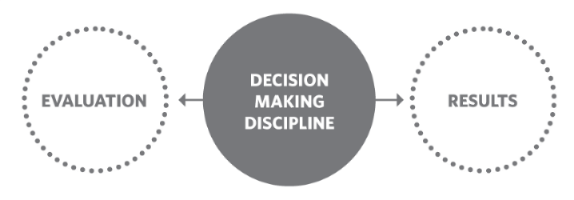
Making good decisions is not a matter of luck or innate ability.
IT IS A DISCIPLINE THAT CAN BE TAUGHT.
BCG’s consultants have made a career out of building organizations that make good decisions. Those organizations have gone on to generate hundreds of millions of dollars in investor returns. The keys to our decision making process are understanding the goal (what the organization is trying to accomplish) and identifying bias (the underlying beliefs we all use when making decisions but don’t think about).
Understanding the goal is the easy part, as long as everyone is on the same page. Understanding bias is more complicated and requires a disciplined thinking method. In any thought process, a person will make logical mental steps from point A to B to C. These steps can cover a lot of ground. That ground is made up of that person’s bias. Essentially, they are beliefs that have proven themselves to be true so many times that there is no longer any reason to think about or question them. However, we live in a dynamic world. No two problems are exactly the same. Biases must be exposed and evaluated to make sure they are still true and that they apply to the decision at hand. Sometimes one or more of our biases turn out to be false. When those false biases are identified, new possibilities arise. That is what creates the “aha moment.”
Coupled with a clear understanding of your goal, BCG’s proven decision making discipline is the how of creating and implementing scalable strategies to improve your business.

CULTURE
CULTURE
YOUR MEETINGS SUCK.
NO REALLY, THEY DO.
Whether it is the overall mission of the company, a new sales strategy, a simple planning meeting, or answering a question from a customer, consistent good decision making is impossible unless everyone involved understands the goal.
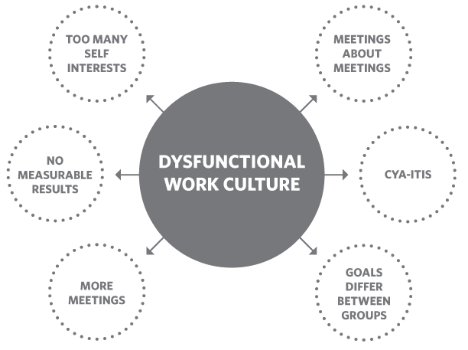
We have found that while most senior management teams all understand their company’s goals, middle management and individual contributors often do not. Even worse, many employees often think the company’s goals are something entirely different from the goals of senior management. This creates predictable organizational dysfunction.
The same dysfunction is also frequently seen in team meetings when the goal of that meeting is not clearly stated and understood. Without this understanding, meetings can quickly devolve into a conversation of individuals motivated by their own self-interests (think of the last meeting where one person was clearly in self-preservation mode, another was self-aggrandizing, and the majority of everyone else were checking their phones praying for it to be over). The good news is that this is easily corrected through cultural change.
BCG will help you implement that change.

REVENUE GROWTH
REVENUE GROWTH
Just sell more.
SOUNDS SIMPLE. SO WHY ISN'T IT?
The truth is that selling more actually is simple, it’s just really hard to actually do. As a result, the business community has made growing revenue overly complicated..
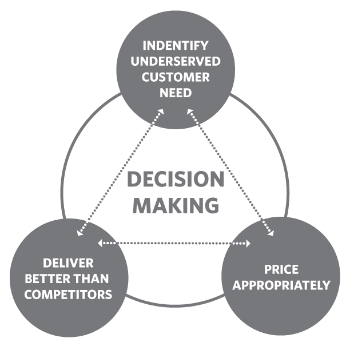
That is why there are so many sales strategy books, marketing and branding consultants and agencies, and strategic consulting companies. While solid sales, branding, and go-to-market strategies are all important, they will all fail if you are selling something the customer doesn’t want at a price they are not willing to pay and deliver it poorly. In reality, if a company is selling something that addresses an underserved customer need, prices it appropriately, and delivers it better than their competitors, revenue will grow. Simple. Accomplishing those three things, however, takes a lot of discipline and a ton of hard work. In the end, like most things, growing revenue comes down to execution and decision making. That is what we do at BCG.
Initially, the last point is the most important – delivery. It is a losing battle to try to create new revenue streams while fighting to refill a porous revenue base. Any and all revenue growth strategies are easier to execute if the current revenue base is solid. Customer retention is key. A company that knows how to make good decisions and builds repeatable, scalable processes that ensure consistent high quality delivery retains its customers. Our consultants’ proven track record of process innovation and decision-making discipline will help your company consistently create incredibly satisfied customers.
Once the existing customer base is full of raving fans, it’s time to focus on identifying, assessing and attacking the right underserved customer need. Every industry has something that the customer wish it could do/have that it currently can’t/doesn’t. BCG has a specific, proven methodology to help companies identify this need. We believe that companies, with the right tools, can identify the underserved customer need better than any consulting company.
No consultant can know your industry and your company better than you. We simply give you the right tools.

COST REDUCTION
COST REDUCTION
Spending less is really easy until it isn’t.
SOME CUTS ARE OBVIOUS.
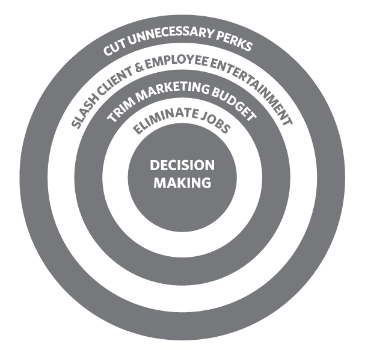
It’s easy, although certainly not enjoyable, to curb unnecessary perks, client and employee entertainment, trim back marketing, freeze hiring, and most painfully, eliminate “non-essential” employees.
Reducing spend after that, without impacting customer satisfaction, is when it gets hard. Companies are often put into positions where they are making the least risky cuts. Once this process begins, it is incredibly difficult to stop the attrition. Inevitably the least risky cut hits a critical system and creates operational dysfunction.
At BCG, we have found that the best way to stem this spiral is to re-evaluate the operations of the company. Most companies already have mature, successful process and procedures. Otherwise, they would not have grown to the size where they need to reduce costs. Many of those companies will have already automated many of these processes. However, there are always opportunities for further standardization – further distillation of complex processes to repeatable tasks.
These tasks can then be transferred from highly skilled labor to entry level positions creating greater capacity within the ranks of skilled labor without increasing cost. Further, repeating this process as companies grow creates truly scalable processes – more throughput, less cost. Simple, but hard. Implementing this kind of scalable, consistent, operational efficiency requires disciplined decision making and excellent execution. BCG teaches companies to do just that.
Once scalable, consistent, and efficient operational processes are put into place, further cost reduction can be realized through offshoring. BCG operates turn-key offshoring facilities in India and Poland.